
Apple Expands Health Features With Apple Intelligence
As an Amazon Associate, we earn from qualifying purchases at no cost to you.
Apple is taking another major step into personalized health and fitness technology with new capabilities coming to the Apple Watch and Health app. The company has announced the Apple Watch Series 12 and Apple Watch Ultra 4, featuring a new Health Sensing System designed to deliver more frequent heart-rate and heart-rate variability measurements, alongside a new daily readiness score.
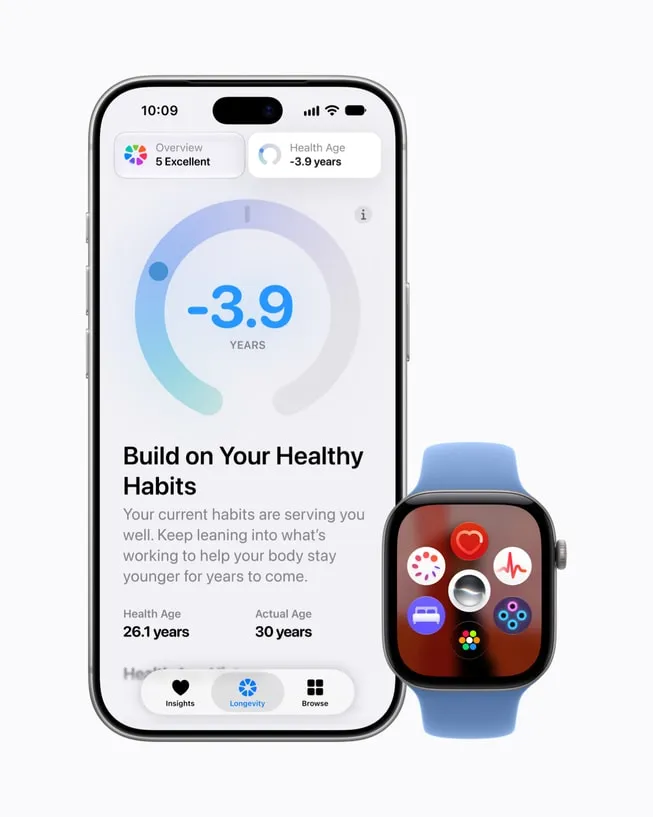
At the same time, Apple is redesigning its Health app to use Apple Intelligence for more personalized health insights, including a new Longevity tab, Health Age feature, at-home movement evaluations, expanded lab testing, and new support for perimenopause and menopause.
Together, the updates are positioned as a broader effort to turn wearable and health data into practical, easy-to-understand information while keeping personal health data private and under the user’s control.
Apple Watch Series 12 and Ultra 4 Get a New Health Sensing System
The new Health Sensing System is one of the biggest health-focused additions to Apple’s latest wearable lineup. Apple says the system combines new optical and electrical heart sensors to enable higher-frequency heart rate and heart rate variability (HRV) measurements.
The system also introduces:
- A new daily Readiness score
- More comprehensive Vitals data
- HRV measurements within the Heart Rate app
- An updated Heart Rate app
- More frequent passive heart-rate monitoring
Apple says a scientific study involving more than 1,000 participants found that the new Apple Watch heart-rate sensing system delivered the highest heart-rate accuracy among the wearable devices evaluated.
Heart Rate Measurements Every Five Seconds
Apple Watch Series 12 and Apple Watch Ultra 4 can measure heart rate every five seconds throughout the day using larger, power-efficient green LEDs in the optical heart sensor.
The company says this continuous measurement can provide deeper insight into fitness and physiological state while also improving the accuracy of Exercise and Move activity tracking.
Users can view their current heart rate through the updated Heart Rate app and new watch face complications.
HRV Monitoring Becomes Much More Frequent
Heart rate variability is another major focus of the new Apple Watch health system.
Apple says HRV, which can provide information related to stress and recovery, can now be measured as often as every five minutes—24 times more frequently than before.
The Apple Watch provides two HRV measurements:
- Recovery HRV, intended to help identify daily signals related to stress and recovery
- Overall HRV, designed to provide broader health insights, including cardiovascular health
Apple notes that higher HRV is generally associated with better overall recovery.
The Vitals experience also gains new capabilities. Overnight vitals can now include Recovery HRV analyzed against a person’s personal baseline, while a new daytime view allows users to compare daytime and overnight measurements.
Apple Introduces a New Readiness Score
One of the most consumer-friendly additions is Readiness, a daily score designed to help users understand how prepared their body may be for the day ahead.
The feature analyzes recent:
- Activity
- Vital signs
- Sleep score
It then produces a 0–10 score and one of four recommendations: Recover, Pace Yourself, Ready, or Go For It.
Readiness isn’t necessarily a static morning assessment. Apple says the score can update during the day as new information becomes available, such as following an intense workout or when daytime vital measurements change.
The scoring algorithm was developed using data from Apple’s Heart and Movement Study in collaboration with exercise scientists and physicians.
Redesigned Apple Health App Puts Apple Intelligence at the Center
Apple is also giving the Health app a significant redesign with Apple Intelligence integrated into the experience.
With iOS 27 and iPadOS 27, Apple says the Health app will provide users with a broader view of their long-term health while also presenting easier-to-understand daily insights.
The redesigned experience is intended to dynamically adapt to an individual’s health and fitness metrics and provide personalized guidance. Apple also emphasizes that the Health app has been designed to protect health data securely and privately.
New Insights Tab
The new Insights tab brings information from multiple areas of the Health app together, including:
- Heart health
- Sleep
- Readiness
- Fitness
- Vitals
- Cycle tracking
A new For You section will provide personalized recommendations and relevant health content based on a user’s data. For example, the app could suggest improving a wind-down routine after a period of late nights.
This approach could make health data more useful for people who find raw measurements difficult to interpret, although the information should still be viewed as a complement to—not a replacement for—professional medical advice.
New Longevity Tab Adds a Longer-Term View of Health
The redesigned Health app will also introduce a Longevity tab focused on longitudinal health data.
Rather than concentrating solely on today’s measurements, the feature looks across areas such as:
- Heart health
- Sleep
- Mental wellbeing
- Movement health
- Metabolic health
- Hearing
- Nutrition
One of the headline features is Health Age, which uses Apple Watch data to show how selected health metrics are tracking relative to a person’s chronological age. Apple says the algorithm can incorporate measurements such as VO2 max, resting heart rate, sleep and HRV. Users can also add laboratory information such as A1c and LDL results.
The Longevity experience can also draw on information from iPhone, Apple Watch, AirPods, clinical health records, and third-party apps and devices.
At-Home Movement Evaluations Use the iPhone Camera
Apple is expanding health assessments beyond traditional wearable measurements with new Movement Evaluations.
Users will be able to perform physical assessments at home using an iPhone camera and Apple Watch. According to Apple, the assessments can measure:
- Flexibility
- Strength
- Balance
- Movement mechanics
- VO2 max
The experience runs entirely on the device, and Apple says no video is recorded, stored or shared. Vision-based AI models provide real-time audio and visual feedback, while the assessments were developed with clinician input.
This represents an interesting convergence of smartphone cameras, wearable sensors and on-device AI for fitness and movement tracking.
Health App Adds Direct Access to Lab Testing
Apple is also expanding the Health app into laboratory testing.
Users can already import existing laboratory results into the Health app. The company says they will be able to schedule and purchase new lab tests through the app, with panels covering more than 50 key biomarkers.
The announced price is $119, with testing available through approximately 2,000 Quest Diagnostics locations in the United States.
The app will also connect laboratory results with educational content. For example, Apple says users could receive expert video content explaining an LDL result and steps they might take to improve it.
Apple Expands Perimenopause and Menopause Support
Cycle Tracking is receiving another significant update with perimenopause and menopause support.
With iOS 27, users will be able to record whether they are in perimenopause or menopause, track symptoms and monitor cycle changes over time.
The feature will also include notifications about cycle deviations associated with perimenopause. Apple says users age 40 and older may receive a notification when changes in logged cycle patterns are suggestive of perimenopause, giving them an opportunity to discuss the changes with their doctor.
Apple also says that users who log bleeding after menopause will receive a notification recommending that they speak with their doctor.
The new experience includes educational material and tips informed by clinical experts.
More Apple Health and Fitness Updates Are Coming
Apple is adding several other health and fitness features across iOS 27, iPadOS 27, macOS 27 and watchOS 27.
Workout Buddy will work directly on Apple Watch even when an iPhone isn’t nearby. The feature will also incorporate additional fitness data when providing motivational insights and will be available in English and Spanish.
Apple is also expanding GymKit functionality. AirPods Pro 3 users will be able to sync heart-rate data through an iPhone with compatible gym equipment, including treadmills and indoor bikes.
New machine-learning models are also being used to improve treadmill distance calculations from the beginning of a walk or run.
What Apple’s New Health Features Mean for Wearable Technology
Apple’s latest announcements show how health technology is moving beyond simply recording individual measurements.
The Apple Watch’s more frequent heart-rate and HRV monitoring provides a larger stream of physiological data. The new Readiness feature then attempts to turn that information, along with sleep and activity data, into a simple daily recommendation.
Meanwhile, the redesigned Health app takes a broader approach by combining wearable data, smartphone information, clinical records, laboratory results and third-party health information.
The biggest shift may be the role of artificial intelligence. Rather than requiring users to interpret every metric themselves, Apple is using Apple Intelligence to organize information, identify patterns and present personalized insights.
That could make health tracking more accessible—but health scores and AI-generated insights should still be understood as informational tools rather than medical diagnoses.
When Will the Redesigned Apple Health App Be Available?
Apple says the redesigned Health app will be available later this year, initially in U.S. English, with additional languages to follow.
The new health sensing capabilities are being introduced with Apple Watch Series 12 and Apple Watch Ultra 4, while many of the broader Health app features are tied to Apple’s upcoming software updates.
The Future of Personalized Health Technology
Apple’s latest health announcement highlights a larger trend in consumer technology: the growing use of AI and wearable sensors to transform continuous personal data into understandable health and fitness guidance.
From five-second heart-rate measurements and more frequent HRV readings to Readiness scores, Health Age, movement assessments and personalized health content, Apple’s ecosystem is increasingly designed to connect individual measurements into a broader picture of wellbeing.
The key question will be how effectively these features translate complex health data into useful guidance without overwhelming users—and how consumers balance the convenience of personalized health technology with the importance of professional medical care.
For now, Apple’s latest updates position the Apple Watch and Health app as increasingly sophisticated tools for personal health tracking, fitness optimization and long-term wellness insights.

 Hi, I'm Ryan! I've worked in the IT industry for over two decades and I love checking
out new gadgets, apps, and services that make our lives easier.
Hi, I'm Ryan! I've worked in the IT industry for over two decades and I love checking
out new gadgets, apps, and services that make our lives easier.